Two identical skis, one maintained and the other not, do not ski alike after two weeks: the first turns and glides, the second skids and sticks. Maintenance comes down to two jobs — waxing the base, sharpening the edges — which a resort workshop does in an hour for twenty to forty euros, and which you can learn to do yourself.
Wax: to glide, and to protect
A ski’s base is porous polyethylene. Wax is a paraffin that soaks into those pores and makes it glide; without it, the base oxidises, whitens and brakes. A well-waxed ski glides on the flat, does not stick in wet snow and wears less.
When. Every three to five days of skiing. More often in spring, when wet snow sucks out the wax, and in deep cold, when abrasive snow rasps it off. Always before summer: a thick wax left on the base, unscraped, protects it until the next winter.
Which. Waxes are sorted by snow temperature — cold, medium, warm — or universal. For most skiers a universal wax is enough; temperature waxes are a racing refinement. Since 2021 fluorinated waxes are banned in competition and withdrawn from sale; what is sold today is fluor-free.
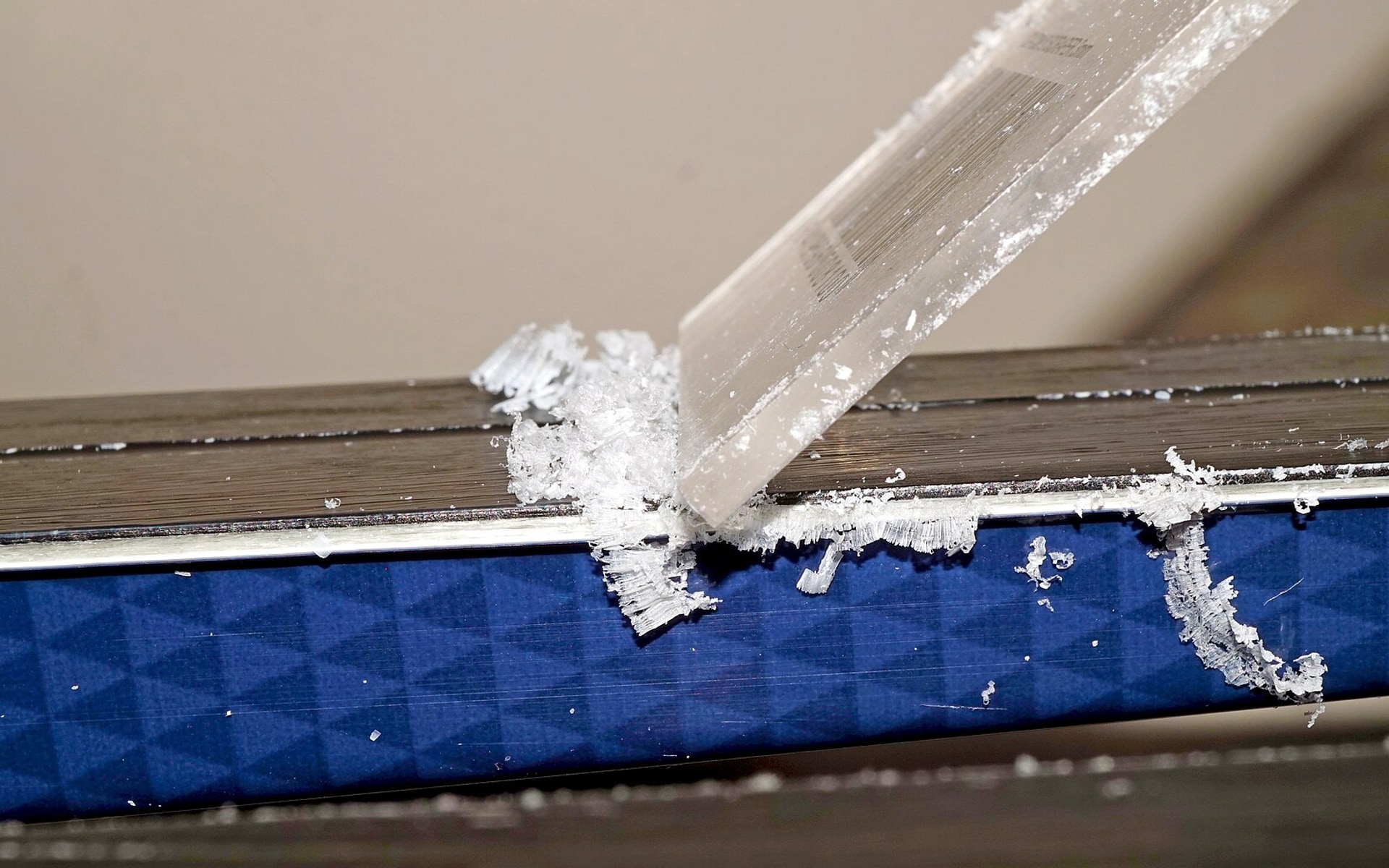
How, at home. A waxing iron — a steam-free clothes iron will do, set low — melts the wax in drops onto the base, then spreads it in continuous passes without ever stopping. Let it cool half an hour, scrape the excess with a plastic scraper from tip to tail, brush in the same direction. Twenty minutes a pair.
Edges: to grip
The edges are the two steel strips bordering the base. They are what makes a ski bite hard snow. They dull on rocks, on ice, and simply with time; a dull edge makes the ski skid in turns on groomed piste, and the skier thinks they have lost their level.
The angle. An edge is sharpened on two faces: the side edge, at 88 or 89° to the base — 90° is the factory angle of rental skis, 88° that of demanding skiers — and the base edge, lifted 0.5 to 1° so the ski does not “catch” when flat. These angles are held with an angle guide, a plastic or metal piece that holds the file; without a guide, you round the edge.
The stroke. File in the guide, regular passes from tip to tail, without pressing. A deburring stone finishes the job. Fifteen minutes a pair, every five to ten days of skiing, and after every contact with a rock.
What you leave to the workshop. A deeply gouged edge or a base scratched down to the core needs a machine: the belt sander flattens the base again, the stone grinder cuts the micro-grooves that channel water away, and the edge grinder restores the angle along the whole length. That is the “full tune” service of resort workshops, to have done once or twice a season.
Base repairs
A hole in the base — a rock at the edge of the run in spring — is filled with a polyethylene candle: melt it drop by drop into the hole, let it harden, scrape flush. A ten-minute job that stops the hole from growing and letting water in. A hole that reaches the core or a delaminated edge means the workshop, and sometimes the end of the ski.
Summer and bindings
Skis waxed without scraping, stored flat or upright somewhere dry, away from a radiator that would warp the camber. Bindings at rest — DIN turned down to minimum on old spring bindings, which recent models make unnecessary. At the start of the season, a visit to the workshop for a binding check: the subject of another article.
Rentals: what changes
A rental ski goes through the machine between two customers in the good resorts, and not in the others. At the counter, run a nail across the edge and look at the base: white and dry, it has not seen wax for a long time. Asking for another pair is not being fussy.