A skier with sore feet does not ski; they wait for lunchtime. And most sore feet are in boots that are too big — not too small — because people try them on like street shoes, looking for first-minute comfort. A ski boot is chosen on three numbers, and kept five to ten seasons. It deserves more attention than the skis.
Size: Mondopoint, not your shoe size
All ski boots are measured in Mondopoint: the length of the foot in centimetres, in half-centimetre steps. A 27 cm foot wears a 27, or a 27.5. It is the only size that does not lie — European equivalents vary from one brand to another.
How to measure: standing, heel against a wall, a mark at the tip of the longest toe, on both feet — they often differ by a few millimetres, and the larger one counts. Then take the exact size, not the one above. Liner new and foot warm, the toes should touch the end when standing, and pull back slightly when you flex the knees forward. The liner packs out by several millimetres in a few days; a boot that is “comfortable” in the shop is too big after a week.
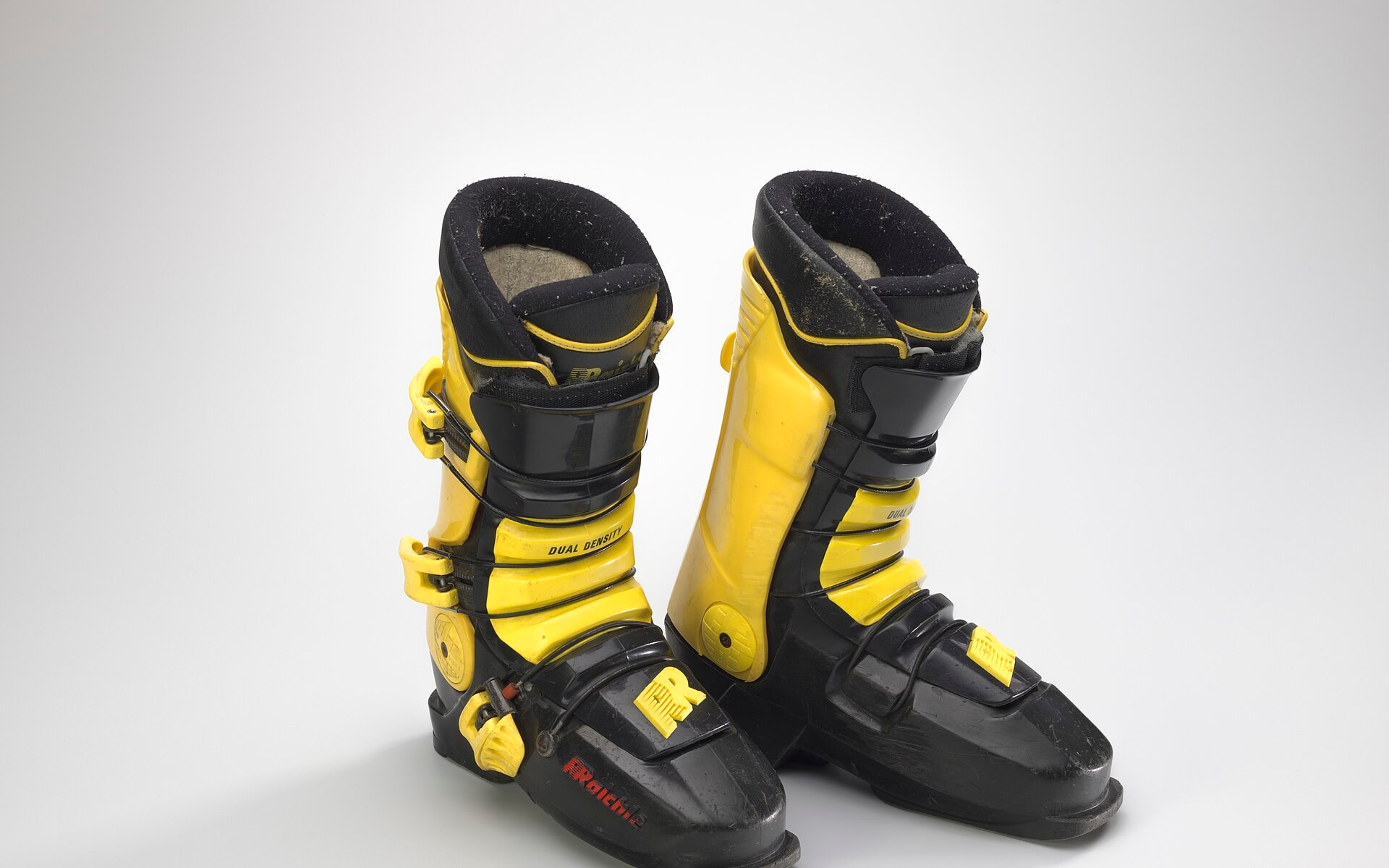
The fitter checks with the shell fit: liner removed, foot in the shell, toes at the end, there should be one to two centimetres left behind the heel. Less is too small; more, too big.
Flex: stiffness, by weight and level
The flex is the forward stiffness index of the cuff. It runs from 60 to 140 and beyond, and it is not standardised: a flex 100 at one brand is not another’s. Read it as an order of magnitude.
Three benchmarks. A beginner or a light skier: 70 to 90. An average skier of average build: 90 to 110. A good skier, a heavy build, or a skier who wants precision on hard snow: 110 to 130. Beyond that is racing, and uncomfortable for everyone else.
Weight counts as much as level: at equal level, 90 kg flexes a boot that 60 kg cannot bend. And cold stiffens plastic — a boot that flexes well in the shop at 20 °C is a notch harder at −10 °C on the chairlift.
Width: the number people forget
The last width at the forefoot, in millimetres, is the third number. Narrow boots are 97-98 mm, medium 100-102, wide 103-106. A wide foot in a narrow boot hurts from day one; a narrow foot in a wide boot floats, and the skier tightens the buckles until the circulation stops — the leading cause of cold feet.
The shop measures foot width along with length. If you do not know yours, ask: it is the piece of information that prevents the most mistakes.
Bootfitting: what the shop can do
A modern boot is heat-mouldable: the liner, and often the shell, are heated and shaped to the foot in half an hour. A localised pressure point — ankle bone, top of the instep, fifth toe — is treated by hot-stretching the shell. A moulded footbed straightens a foot that collapses and changes the feel of the boot more than any adjustment.
That is what separates a ski shop from a supermarket aisle, and what justifies buying boots where you can come back to have them adjusted. A boot bought online without trying it on is a bet that often loses.
Rent or buy
A rental boot is set for the average foot, and its liner has already taken the shape of the hundred skiers before you. It is enough for one week a year. For two weeks or more, or as soon as your feet hurt in rentals, your own boot is the first purchase to make — before skis, which rent very well and wear out fast. A €300 to €500 boot lasts five to ten years; per day, it is the cheapest item in a ski week.
In the shop, in order
Measure both feet, length and width. Try the exact size with a thin sock. Stand ten minutes, flex, walk. Check the shell fit. Ask for heat moulding. And leave with a boot that is snug — not one that hurts, but one that holds — because that is the one that will be perfect after three days.