Two resorts at the same altitude, under the same sky, with the same snow fallen, do not have the same snow on the ground in March. The difference is in the orientation of the slopes. A north-facing slope sees the sun at a low angle; a south-facing one takes it head on. At the scale of an area, that difference can be measured — and our pages measure it.
What the measurement says
For each run mapped on OpenStreetMap we compute its fall line — towards which compass point it descends, hence which slope it occupies — and weight by its length. The result, for each resort, is a split into four shares: north, east, south, west.
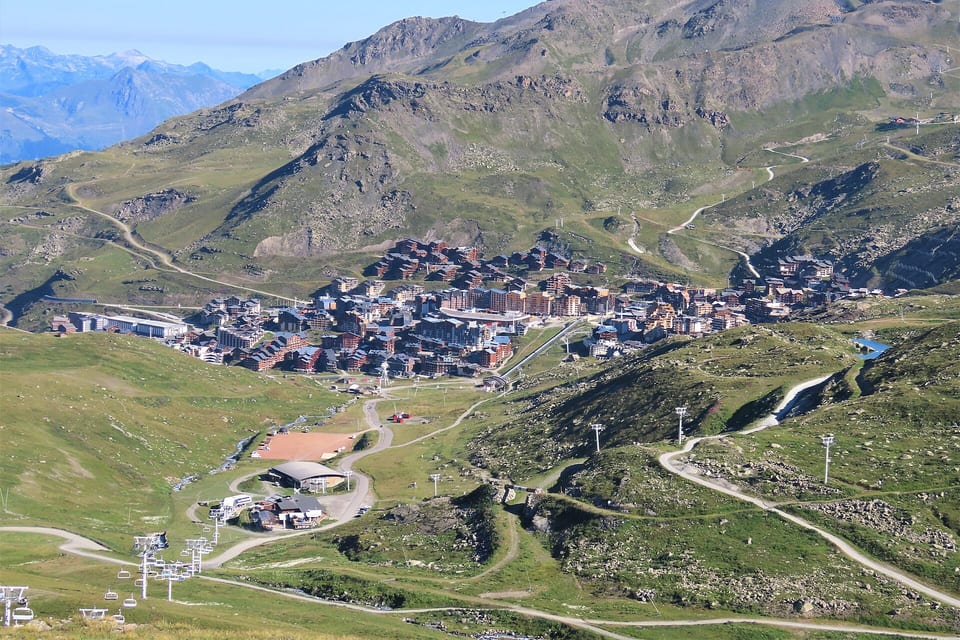
Val Thorens, measured over 181 runs: 43 % west, 38 % north, 12 % south, 7 % east. A high-altitude area facing west and north, which explains — with the village’s 2,300 m — why it opens in November and closes in May.
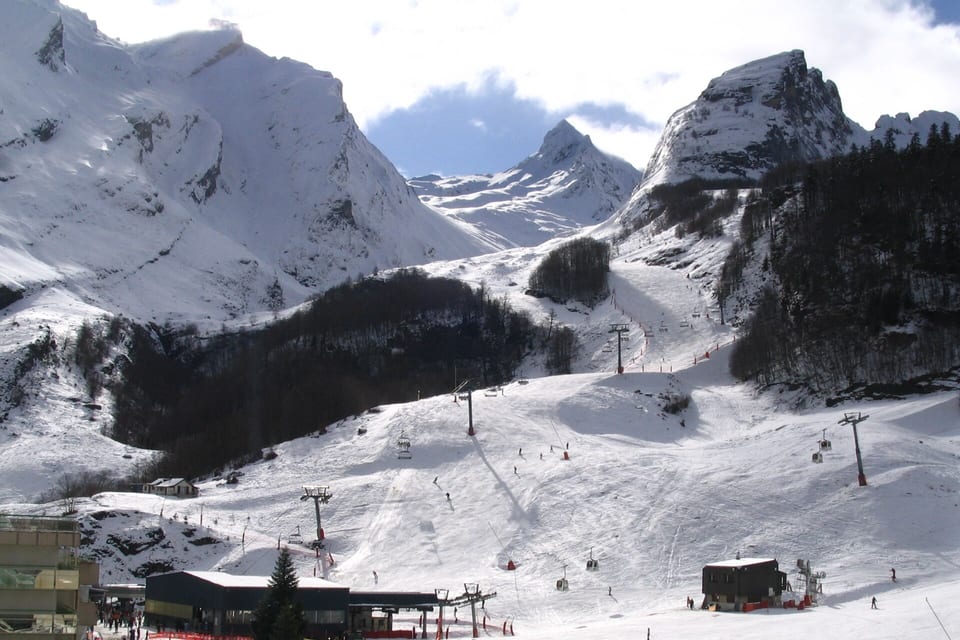
Gourette, in the Béarn Pyrenees, 48 runs: 89 % north. An area between 1,400 and 2,400 m that skis like a much higher one, because the sun barely touches it. Les Monts d’Olmes, in the Ariège, 91 % north over 27 runs; Combelouvière, in the Tarentaise, 96 %.
La Rosière, in the upper Tarentaise, 72 runs: 55 % south, 6 % north. The resort sells itself as the sunniest in the Tarentaise, and the measurement confirms it. Champagny-en-Vanoise, 56 % south; Chaillol, 75 %.
What it changes by month
In December and January, the sun is low and the days short: a south-facing slope stays cold, the snow lies, and the light is a luxury. South-facing areas are the best midwinter choices — especially for beginners and children, who ski longer when it is pleasant.
In February, everything is still equal, except the bottom of south-facing runs in low resorts.
In March and April, the order reverses. The sun climbs, south-facing slopes transform from mid-morning and strip at the bottom. North-facing slopes keep cold snow until noon and a snowpack that holds. That is where Gourette catches up with Tignes.
Using it during the day
Regulars do not look at aspect to choose the resort: they look at it to choose the run, hour by hour. East in the morning: first sun, refrozen snow that softens. South in late morning, before it sticks. West in the afternoon, where the sun arrives late. North for powder three days after a fall, and for everything else once spring is here.
The piste map does not say the aspect. Our pages’ map does, and each resort’s page gives its split — with the number of runs it is computed on, because a five-run resort at 100 % north is not a measurement, it is chance.
What the measurement does not say
It does not say the gradient, nor the altitude — two factors that weigh as much. It does not say the shadow cast by peaks, which shelters some south-facing bowls. And it depends on the map: a resort whose runs are poorly mapped has an aspect computed on too few runs, and the page shows that number so you can read it accordingly.