Every winter, the same scenes in the same places: a queue of cars stopped in a hairpin, a driver discovering their chains in the dark, a coach stuck across the road. Most can be avoided with what you put in the boot before leaving. Here is what the law requires, what the mountain imposes, and what our resort pages know about each resort’s roads.
What Mountain Law II says
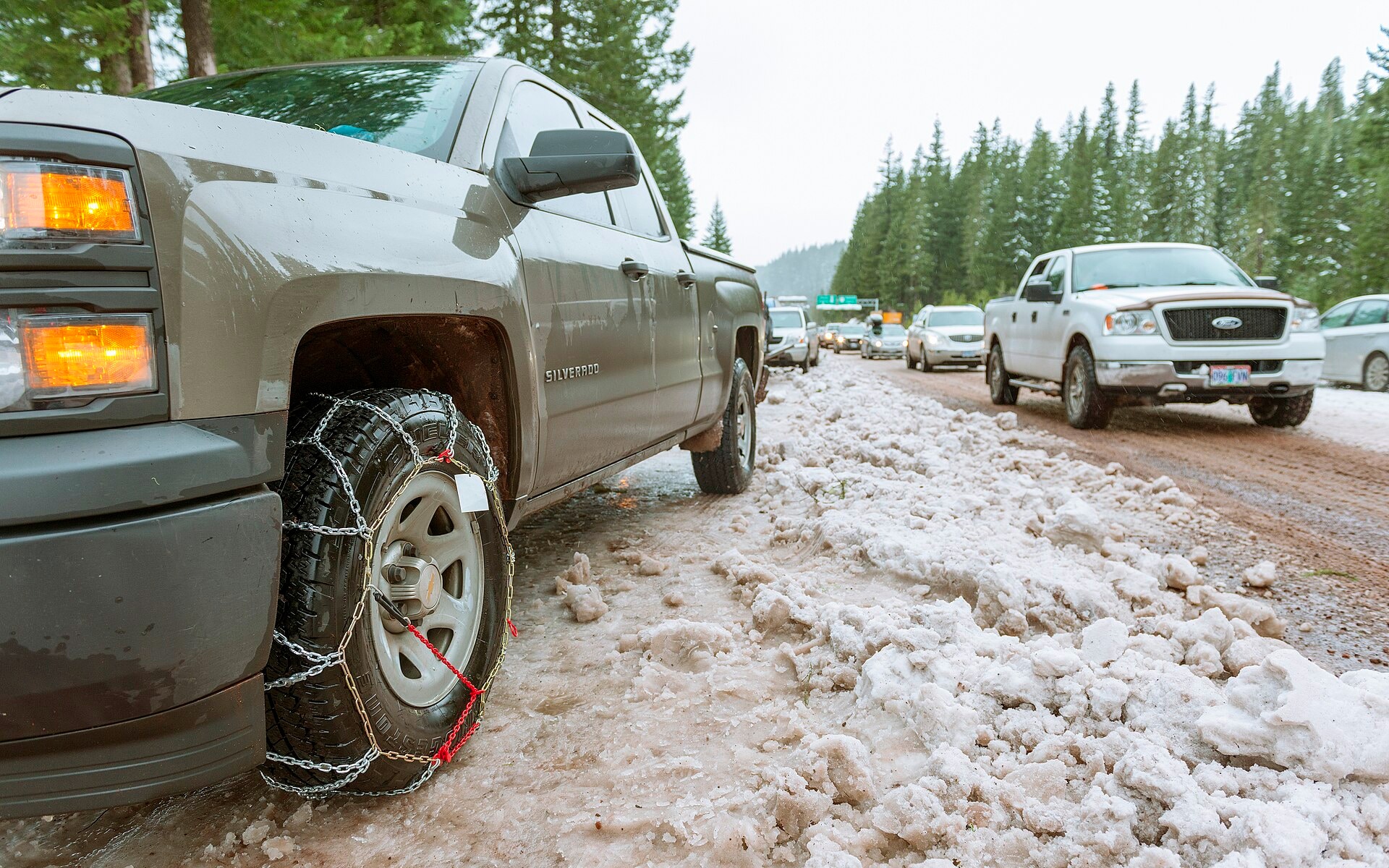
Since 1 November 2021, in the municipalities designated by prefectoral order in 34 mountain départements — essentially all ski resorts — every vehicle must, from 1 November to 31 March, either be fitted with four winter tyres, or carry chains or socks for at least two driving wheels.
A winter tyre, under the decree, carries the 3PMSF marking — the pictogram of a three-peak mountain with a snowflake. The M+S marking alone, tolerated in the first years, has not been since 1 November 2024. Many “all-season” tyres carry the 3PMSF; not all do, and it is written on the sidewall.
The obligation applies to cars, motorhomes, vans and lorries. It is signposted at the entry to the zones by a blue sign with a chained-tyre pictogram. The fine is €135.
What the mountain imposes, beyond the law
The law says “chains in the boot”. The mountain says “chains fitted before the hairpin”. Three rules regulars follow.
You fit chains before, not in it. On an area provided at the bottom of the climb, on the flat, before the road turns white. Fitting chains on a snowy slope, at night, with cars hooting behind, is when people get hurt.
The B26 sign is an order. The round blue “chains compulsory” sign means that from there, winter tyres are no longer enough: chains must be fitted. You see it on the road to Val-d’Isère, Tignes, La Mongie on snowy days.
A hire car rarely has chains. Check at the counter, or buy approved socks before leaving — about twenty euros.
Passes closed in winter
Some mountain roads close from November to May, and a satnav that does not know sends you into a wall of snow. Our driving times, computed on the OpenStreetMap network, avoid passes closed in winter — the Iseran between Val-d’Isère and Bonneval-sur-Arc, the Galibier, the Tourmalet between La Mongie and Barèges, the Lautaret when it closes. When a resort is reached by a detour because of a pass, the page says so: “avoids the Col de l’Iseran, closed in winter”.
And on each “getting there” page, two links: the département’s road information service, which gives the state of the passes and chain obligations in real time, and Bison Futé.
In an electric car
Cold cuts range by a quarter to a third, and a 1,500 m climb uses as much as a hundred kilometres on the flat. Our pages list the publicly accessible charging points within two kilometres of each resort, from the national database — the number of points, the maximum power, the operator. Where there are none, the page says so, with the check date: resorts’ covered car parks often have chargers reserved for their customers, which are not in the database.
The boot checklist
Approved chains or socks, tried once in the garage. A head torch. Gloves that do not mind snow. A scraper. A blanket. A full tank — or battery — in the valley, not in the resort where fuel costs more and chargers are taken. And the page’s driving time, plus an hour on February Saturdays.